Showing posts with label greek riots. Show all posts
Showing posts with label greek riots. Show all posts
Wednesday, 8 December 2010


Wednesday, 9 June 2010
Police officer charged with killing Greek teen in 2008 set free by courts

Despite being witnessed by dozens of people in the neighbourhood and part of it captured on video Greek courts were unable to convict police officer, Epameintas Korkoneas who on December 6th shot and killed 15 year old Alexis Grigoropoulos in Exarchia, Athens. As 18 months had elapsed since the officer's arrest the court was obliged to set him free.
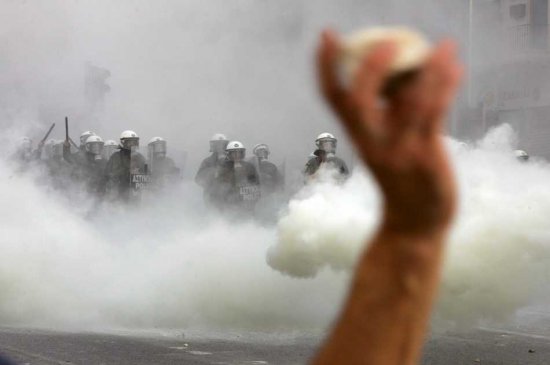
The death sparked off riots that lasted nearly a month and cost the country billions in damages as outraged Greeks repeatedly clashed with police across the country and produced the worst civil unrest in a generation. The ferocity of the response was, in part fuelled by the conviction that the police officer would not be punished.
UPDATE
It seems that the officer has been released but the trial is set to continue. The 18 month limit was how long somebody could be held pre-trial before the courts were obliged to release them. Thanks to blogger Lollipop for putting me right on this.
Wednesday, 5 May 2010


Sunday, 6 December 2009
Protests to mark the first anniversary of death of Greek teen end in clashes

There's nothing like blind terror for letting you know you're alive.Every sensory input suddenly lights up your neurons like a city block decked out for Christmas. You become aware of absolutely everything around you, decisions that you usually kick around your head for minutes are taken in units of times measured in 100ths of seconds. What you don't notice, however, is pain.
After being chased on and off by riot cops and those on motorbikes for more than a kilometre I end up with a couple of hundred kids just below the ministry building, there's no way out as both above and below us are platoons of riot cops who keep on shooting tear gas canisters into the crowd despite the fact that there is nowhere to go. I try to see if I get pass but those ahead of me get beaten and kicked by the riot squad and so forced back into the main mass.
A gas canister, shot out of something resembling an old style revolver smashes into the tarmac next to me, richochetting and striking my leg. In the general panic, I pay it little attention, worried that I too will next in line for a beating and move back, but where? There is nowhere to go.
Eventually, the gas clears and we realise that we are surrounded, police order us to sit down and start insulting and kicking those around the edges. Somebody, injured cries for help, they ignore her and keep on screaming at those on the ground. There are so many people in such a small space that it's nearly impossible to find room. I squeeze in besides some high school students and looking down see that my jeans are red. Is someone hurt, I Look at the guy next to me who appears to be fine. Then it dawns on me that the blood might be my own. I left the leg and see the canister has taken out a chunk of flesh in my shin. It doesn't even hurt, strangely enough.
The cops keep on whacking away at those they consider are not complying with their orders and something in me breaks. I'm not what I wanted to achieve or what good I could do but I get up and start shouting at them in English, "I'm a reporter with Reuters " I lie but that was the first thing that popped into my head, I keep on shouting it in my best "you've been naughty, now sit down" teacher's voice as loud as I can, adding that what happens today will be on the news tomorrow again and again. I'm not sure how much they understand but it distracts their attention and they seem to calm down ,or at least behave. By that time the rest of the media pack have caught up with us and so the police stand down, having more sense than to beat people on live TV.
Those detained are taken in police vans to the central police station in Thessaloniki and who knows what. Their crime simply being in the wrong place at the wrong time.
With the help of the march's legal team I manage to get out and find an ambulance which takes me along with another guy hit in the face by a canister to the local hospital. There we see other injured in a similar way, including a young woman hit in the head, afterwards she told me that her camera had been smashed by the police when she attempted to record their abuse.
According to Greek channel MEGA today has been a great success for the authorities and the police's new hard line has brought results. I think that what they have brought is a new round of escalation which will grow in the coming days.
Saturday, 5 December 2009
Why I march
Tomorrow we march, tomorrow we protest for those who have been lost and to make sure their sacrifice need not be repeated. To tell you the truth I'm scared, I'm sure that there will be clashes with the riot police who have adopted a zero- tolerance policy over the last few weeks.There are also keen to show that they are in charge here and that the streets belong to them and them alone,
So why do I go? That's a tough questions and I'm not sure I have a good answer to that but all I know is that not going is unthinkable. I still feel the the raw battery acid taste of rage in my mouth from when last year's events unfolded, that sense that something is fundamentally wrong with the way we live our lives if the cold blooded killing by the police of a teenager goes unremarked.
Last year I spent the better part of three weeks on the streets covering marches, sit-ins and riots in the hope that somehow the outside world would give a damn. I wanted to believe that what I photographed and wrote about helped changed perceptions about how the violent protests last December were seen by the rest of the world. How arrogant that sounds, but maybe, just maybe I was part of a wave that got out, a different message to the one that the mainstream media here were peddling, that of blind destruction and hooliganism, rather than revolt.
So why do I go? That's a tough questions and I'm not sure I have a good answer to that but all I know is that not going is unthinkable. I still feel the the raw battery acid taste of rage in my mouth from when last year's events unfolded, that sense that something is fundamentally wrong with the way we live our lives if the cold blooded killing by the police of a teenager goes unremarked.
Last year I spent the better part of three weeks on the streets covering marches, sit-ins and riots in the hope that somehow the outside world would give a damn. I wanted to believe that what I photographed and wrote about helped changed perceptions about how the violent protests last December were seen by the rest of the world. How arrogant that sounds, but maybe, just maybe I was part of a wave that got out, a different message to the one that the mainstream media here were peddling, that of blind destruction and hooliganism, rather than revolt.
Friday, 4 December 2009
Athens protests this weekend - A survival guide
Photograph from Greek Riots in Photos - Voyager.gr
I thought I'd share a few tips with those covering the anniversary of the death of the Greek teenager, Alexandros Grigoropoulos this weekend. I hope they prove useful.
1 - The potential for violence has increased rapidly over the last few weeks so be prepared for clashes.
2 - Being a reporter is no guarantee of safety, especially with the police. The Greek cops have a long and inglorious history concerning photographers. They will not hesitate to use force if they feel you are photographing them.
3 - Many of the demonstrators, especially the anarchists view the media and hence reporters with the same contempt they hold for the police. Use discretion when taking pictures around them, if challenged put away your camera immediately unless you want it smashed. However, most other political/social groups are more tolerant of the media.
4 - The riot police have changed tactics recently so expect extensive use of tear gas and flash grenades. Maalox antacid tablets mixed with water can help somewhat. Though not with breathing.
5 - The grounds of the university of Athens are officially off limits to the police, so make sure you know where the nearest entrances are if the police advance. Being a foreigner or reporter will not protect you.
6 - If you do get detained make sure you have ID otherwise you risk days of belong held in a police cell.Try to get the number of some Greek friends in case you get arrested.
7 - Areas such as Exarchia are a rabbit warren of small streets, get familiar with the local geography so that if you have to make a quick retreat you know where you're heading.
8 - Running shoes are a must.
Protesters will be formed into blocks. It is probable that anarchist protesters who have intention to clash will be in groups around protesters' blocks. If they start throwing rocks or other objects at the cops things may escalate in no time. I advise you that when you see the first signs of a clash, stay close to a political/student block.
In case of intense use of tear gas don't panic and don't try to run away from the main group of protesters in alleys etc. The best thing you can do (especially if you can't open your eyes) is get into a group, grab the person next to you and walk together.
A group of lawyers will be around in the protest to provide law advice in case someone gets arrested. These are their phone numbers:
6972-718536
6972-799025
6976-395658
6946-738686
6978-909319
6936-492025
6975-752346
6973-335960
If you get arrested, call them as quickly as you can. Do not sign anything in the police station and have in mind that cops may try to deceive you.
Remembering December 2008

This was taken just after the riot police went in to break up a road block set up by high school students in the centre of Thessaloniki last year during the protests that followed the death of Alexandros Grigoropoulos, shot by the police in Exarchia, Athens.
The clashes between protesters and the authorities lasted for nearly a month.
Thursday, 3 December 2009
Pictures from the Greek uprising - December 2008

Taken during the December riots last year. So many things were happening at the time that I barely had time to take more than a cursory look at my pictures so I only just found these.
Riot police firing tear gas canisters at high school kids who were just a few metres away.
This was taken just moments after a riot cop fired tear gas at them from a range of less than 20m.

Remember, remember 6th December stencil - poster

The stencil is high resolution and you are free to use it in any non-commercial context.
Almost one year ago 15 year old high school student Alexandros Grigoropoulos was shot in cold blood by a police officer in the Exarchia district of central Athens. The authorities originally claimed that Grigoropoulos had been part of a gang that had attacked a passing patrol car with bricks and bottles and that the officers had fired a warning shot which ricocheted, fatally wounding the teenager. However, several eyewitness accounts and video recorded on a resident's mobile phone quickly cast doubts on the official account.
In the hours, days and weeks that followed thousands took to streets and clashed with riot police repeatedly leaving much of central Athens and Thessaloniki resembling a war zone. In addition disturbances spread across the country affecting small towns and islands. The ferocity of the protests took the government and law authorities by surprise, and for the first few days the police were at a loss to control the situation. Faced by the worst civil disturbances in a generation law and order broke down as government offices, banks, stores belonging to multi-nationals and even police stations were torched.
It seemed that for many Greeks, especially those under 25 the situation in the country had become unbearable. Seething resentment over a government mired in scandal, raising unemployment, a shrinking economy and the perception that the police were above the law all combined to form an explosive mix which blew up last December and lasted for weeks.
Although the previous New Democracy government has been replaced by a left wing PASOK one, the legacy of massive public, corruption and nepotism the conservatives left as a legacy means that prime minister, Giorgos Papandreou is faced with the unenviable choice of either letting the country go bankrupt or implementing painful austerity measures which will make a mockery of the party's campaign pledges. Already the failure of Dubai to reschedule repayments on its $60 billion debt has pushed up the cost of Greece's public lending whilst the European Union has demanded that the country subject its public finances to EU oversight following the massive under reporting of debt the previous administration led by Constantinos Karamanlis.
Since December 2008 Greece has also seen a resurgence in domestic terrorism with a number of bomb and machine gun attacks on police officers and other high visibility targets. As well as the more spectacular incidents every week other smaller attacks take place on an almost daily basis as an undeclared war is waged between the far right groups and leftists. In the face of this the possibility that the anniversary of Alexandros Grigoropoulos's death will be marked peacefully grows ever more remote.
For pictures of what happened on the 6th December 2008 click here.
Saturday, 28 November 2009
Greece braces for trouble one year after uprising

On the evening of December 6th Alexandros Grigoropoulos, a 15 year old high school student was shot dead by police in the central Exarchia neighbourhood, Athens. The death was to spark riots and protests throughout the whole of Greece and lead to billions of euros in damages. Whilst clashes between Greeks and the police were fiercest in the country's two largest cities fighting soon spread to even small towns and islands as outraged young people fought with the authorities and attacked shops and offices.
One year on the first anniversary of the shooting many fear that next month will see a re-run of last year's events which took the government completely by surprise and left much of central Athens and Thessaloniki looking like a war zone with burnt out cars and flaming building filling the nightly news bulletins.
Despite the crushing defeat of the previous conservative New Democracy administration in last October's parliamentary elections, the social problems which led to Greece's worst civil disturbances in 40 years have not gone away. Indeed given the deepening recession, the issues of unemployment, deep rooted social inequalities and a lack of hope for the future are even more entrenched than in 2008.
Similarly, Greece's controversial police force appears to have learnt few of the lessons of December and have continued to be dogged by allegations of violence and human rights abuses by international organisations such as Amnesty International.
In addition heavy handed policing tactics during the recent marches for the annual 17th November memorial seems to indicate that the police are ready to take on any challenges to their power and so avoid a repeat of last year's situation where many neighbourhoods became no go areas.
The series of terrorist attacks on police stations and officers plus weekly incidents of bomb attacks on government targets and leftist organisations means that the scene is being set for a showdown between the those unhappy with the present political system and the forces of law and order.
Subscribe to:
Posts (Atom)

For me, however that experience came to me in my forties, hardly an age given over to violent uncontrollable emotion, Yet something in me was woken by the news that police officers had gunned down a 15 year old for no apparent reason in central Athens. I cannot say what I expected when I joined a demonstration on the following morning, an uncharacteristically warm Sunday morning. perhaps a small march with a few hundred (if that) politically active students which would last about an hour before everyone went back home or grabbed a bit to eat.
Instead thousands of people of all ages appeared and then more and still more till the marcher numbered anywhere near 10,000. But as well as the larger than expected turn out I noticed other, more worrisome signs such as the guys rapidly stuffing the necks of beer bottles with cloth.
From the beginning there was a feeling of anger and rage from many in the march, an undefinable sense that some unwritten covenent had been broken and that it wasn't business as usual. That was confirmed when the march verred off its usual route and made its way to the central police station in Aristotelous Square. Moving a little ahead of the front of the crowd I witnessed the first wave of clashes between protesters and riot police, a scene that would be repeated endless times over the following month in Thessaloniki and every other Greek city.
The police responded with endless rounds of tear gas and baton charges yet, almost miraculously people scattered then reformed, determined not to be intimidated by them. The rage and anger towards the police then mutated as the protests went on day after day into a general sense of violent discontent with the authorities in general.
Witnessing these events reminded me of all the account I had read of the student revolts of the late Sixties including Paris in 1968. Yet these protesters were not just teens or college students but rather came from virtually every age group including pensioners who red with anger would hurl the most furious insults at police officers.
The other aspect of the events of December and January was the sense of unreality that came from listening to the mainstream Greek media's account of the events which ranged from clueless to perneciously misleading. At a loss to explain a revolt which owed nothing to traditional party politics they attempted to describe it either in terms of mindless hooliganism or shadowy conspiracy theories.
It was then that I realised the true power of internet tools such as Twitter, Facebook, Youtube and blogs as they quickly proved a far more reliable source of information than TV stations which lumbered through the crisis like a half-blind brontosauras.
Two years on the conditions which fuelled the massive protests of 2008 have worsened still further and the anger feel by many then has grown and intensified as people feel betrayed by their leaders. The ruling political caste seems even more cut off from its popular grassroots support than ever before and seem oblivious that they are standing in the middle of a pool of petrol flicking cigarette butts into the void.